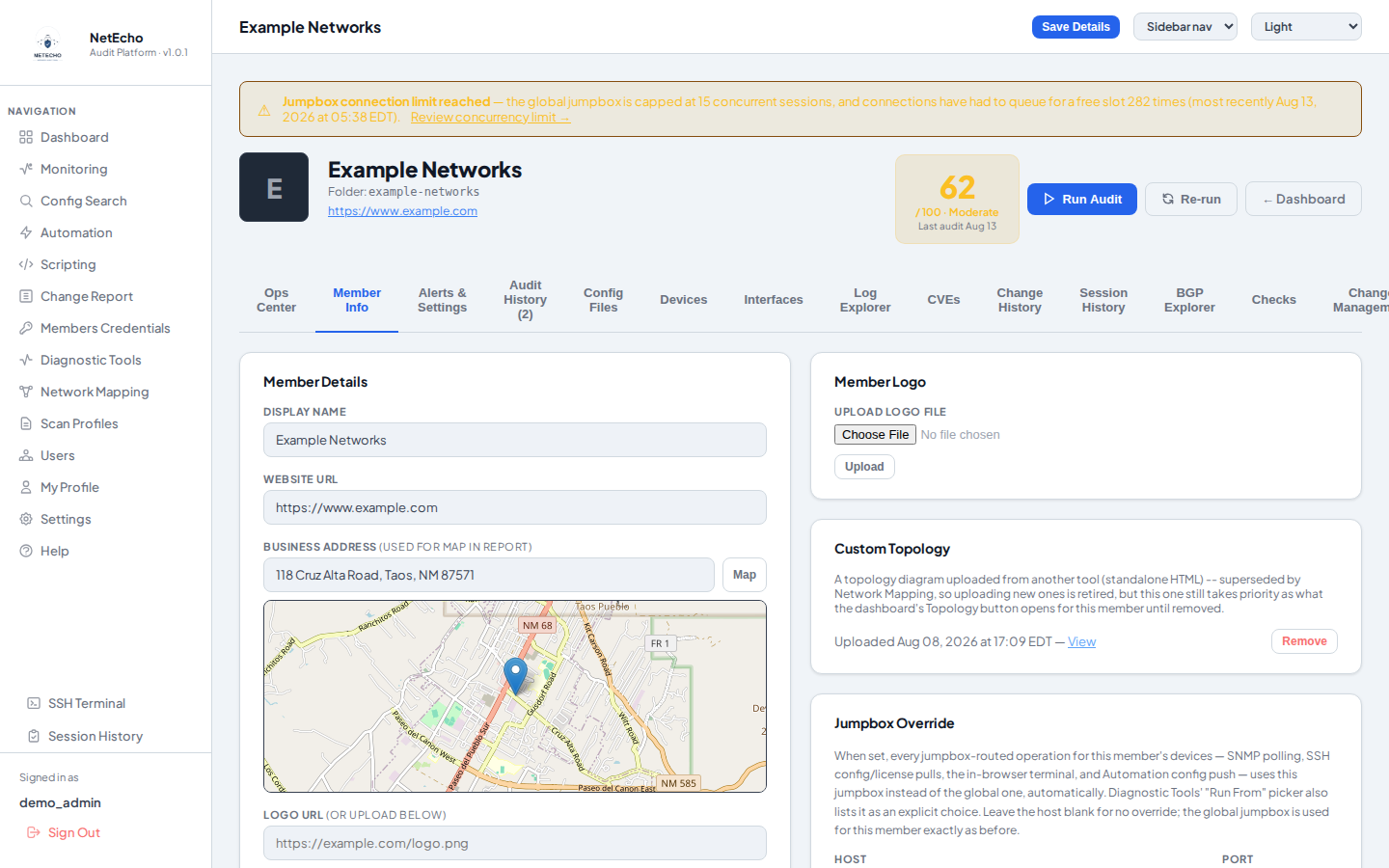
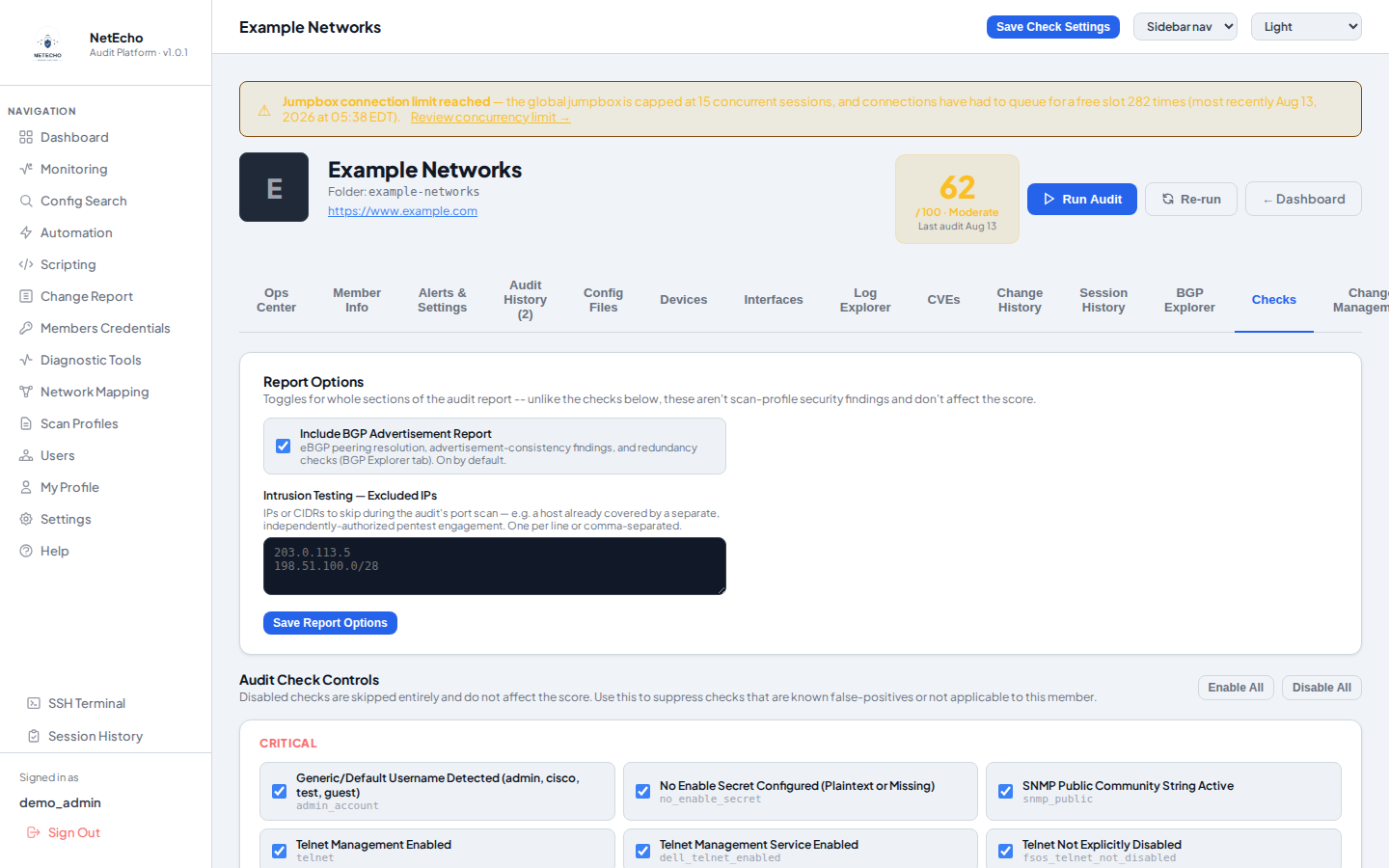
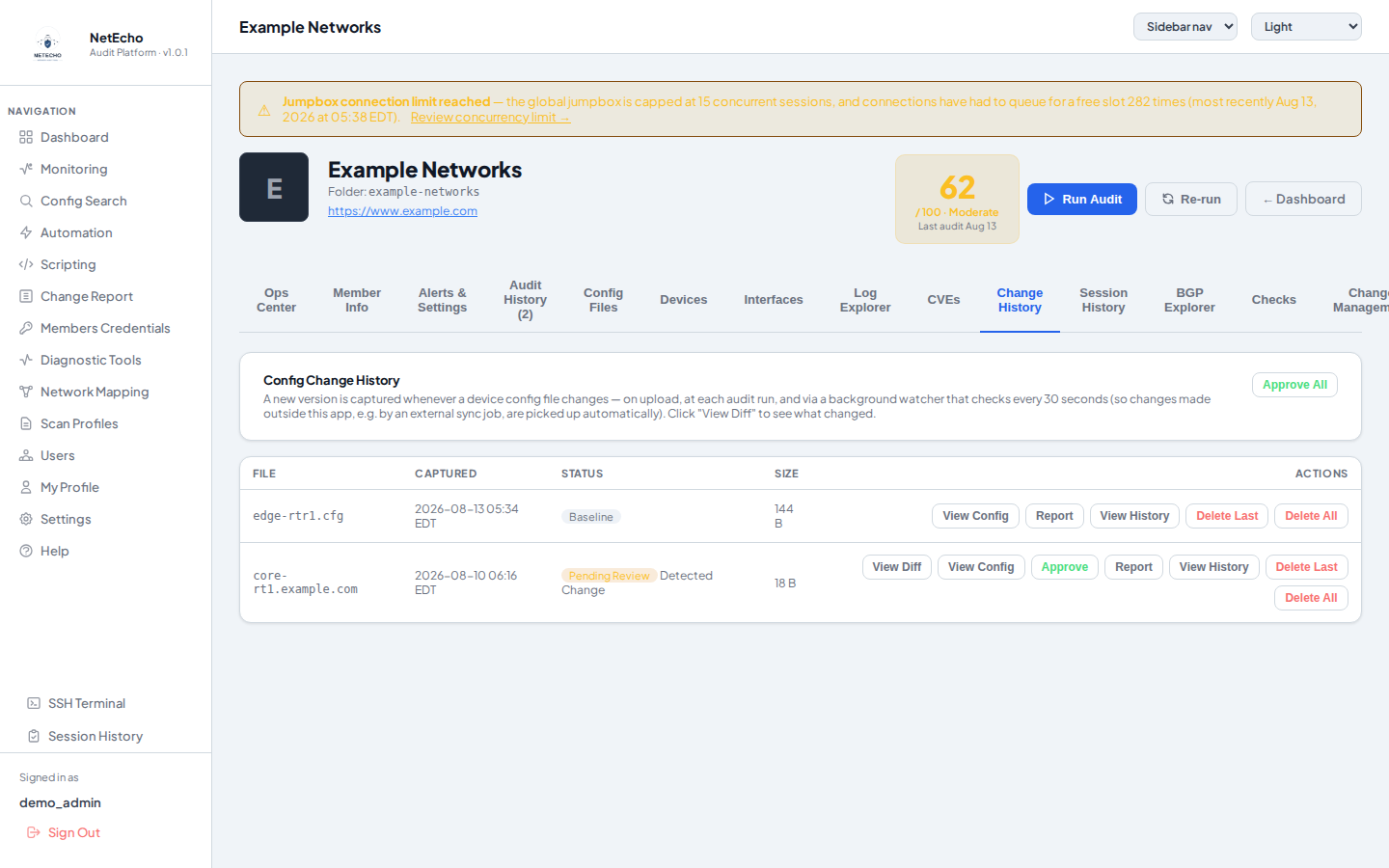
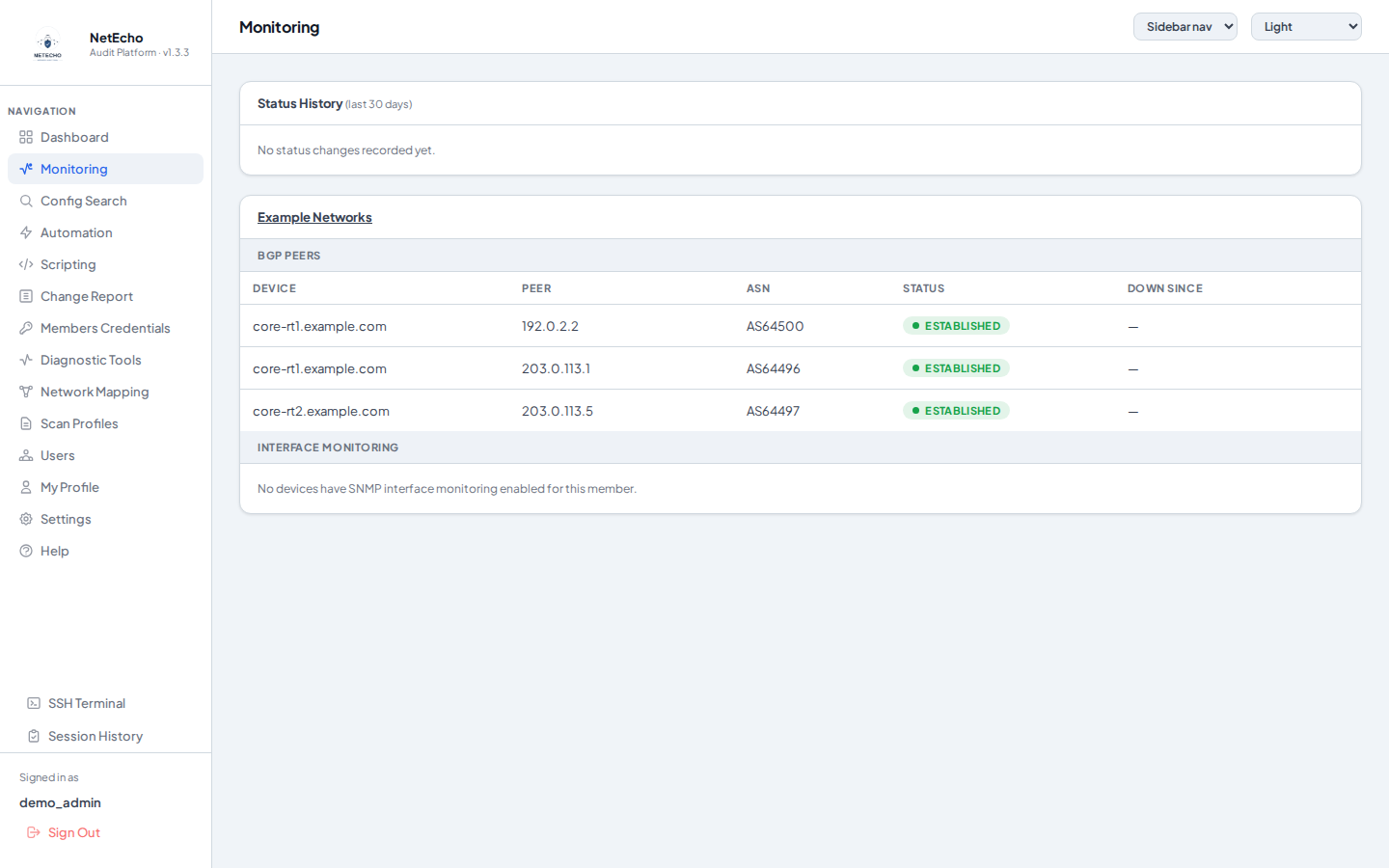
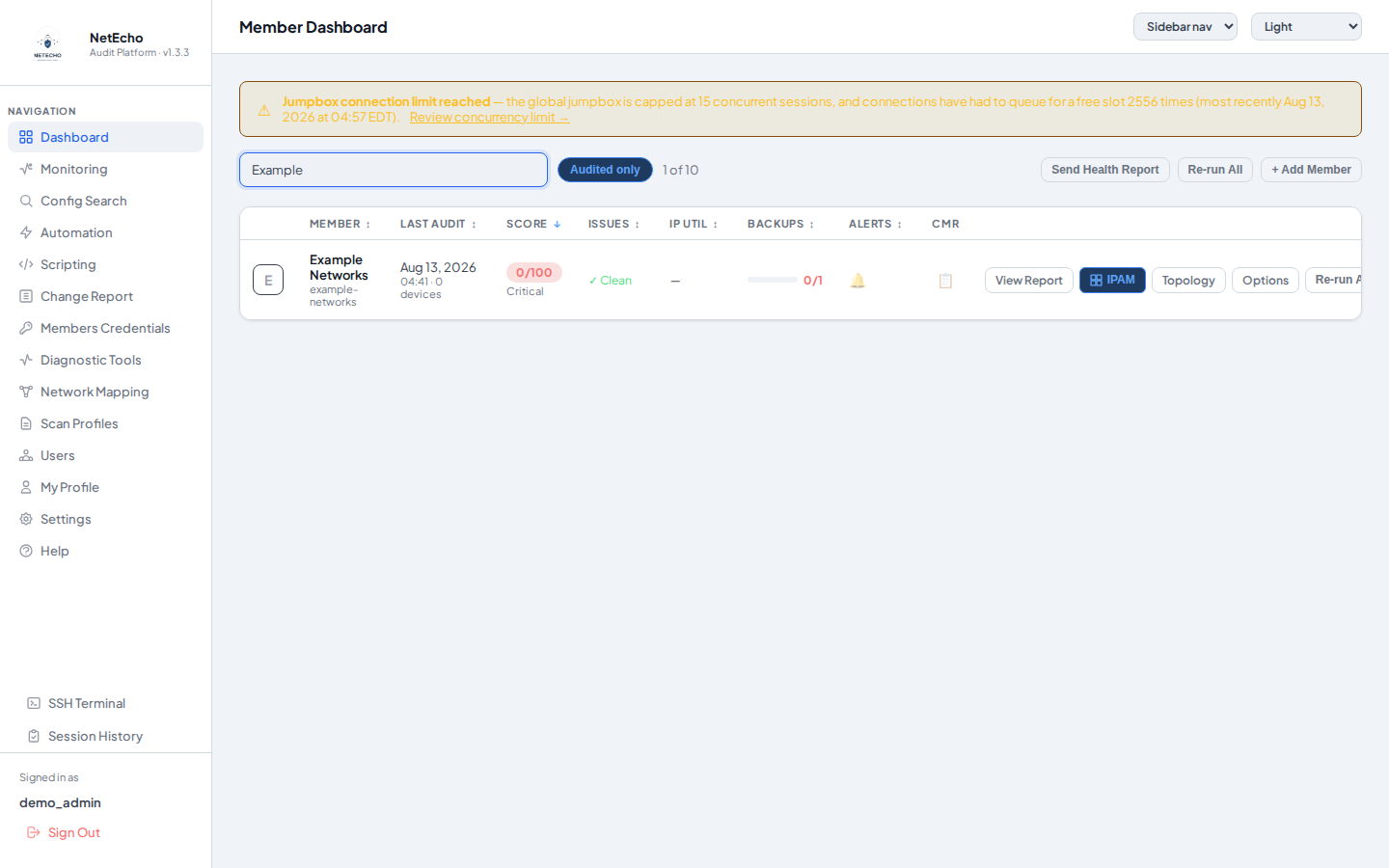
Continuous network security auditing, live monitoring, and configuration management — one platform an MSP or ISP runs their whole fleet from, and hands each customer their own window into.
WatchTower is two products that happen to share a login. Neither one is a bolt-on to the other — and both scale across as many customer networks as you manage.
Analyzes every managed network's configs for security misconfigurations, scores them the same way every time, and delivers alerts and customer-ready reports automatically — on a schedule, not as a one-off engagement.
A working NCCM system: inventories devices, version-controls every config change, pushes updates through verified automation, gives you a live SSH terminal, tracks CVEs, and monitors uptime — all on the same inventory.
The realistic alternative to running this isn't a faster manual audit — it's not auditing at all, or auditing once and calling it done. Here's what one real pass over a fleet actually runs, by size.
| Fleet size | One manual pass | To stay current (quarterly) |
|---|---|---|
| 200 devices | 100 hrs · $8,500 | $34,000 /yr |
| 400 devices | 200 hrs · $17,000 | $68,000 /yr |
| 600+ devices | 300+ hrs · $25,500+ | $102,000 /yr |
A misconfiguration doesn't wait for the next scheduled audit to become an outage or a breach. And "we hadn't audited that part of the network yet" is not a defensible answer — to a regulator, an insurer, or a customer. The hours above buy one dated snapshot; WatchTower keeps the fleet current for a fraction of the recurring labor cost, freeing that engineer time for revenue work instead of checklist work.
Not knowing about a gap doesn't reduce exposure to it — it only decides who finds it first: you, or whoever's already looking for it.
Every device is re-scored the day a change lands, and the full fleet can be swept on demand or on a schedule against the National Vulnerability Database's live CVE feed — matched to each device's exact platform and firmware via CPE version matching, not a generic "IOS has a CVE" alert. New exposure surfaces within a day, not months later at the next manual review.
Not just config review — actual exposure, actual redundancy, actual IP usage, and actual recoverability, verified against real external data.
A route can be misconfigured and never advertised, or correctly configured but silently not carried. A port can look closed on paper and still be reachable. WatchTower verifies the actual state, not just the intent in the config — and keeps a recoverable copy of that config on hand either way.
A background watcher fingerprints every config every 30 seconds. Nothing changes without a record, and sensitive networks get their own rules enforced automatically.
A missed or unauthorized change is one of the most common causes of a network incident. This turns "did anything change?" from a question someone has to remember to ask into something the system already answered.
Ping-based device status and live BGP peer state, side by side, refreshing automatically — with alerting that actually reaches someone.
Knowing a feature is "turned on" isn't the same as knowing what's actually down right now. This is the one place that answers it — for every customer, automatically.
A simple scripted language drives the session exactly as written, and a push is only ever marked "passed" once it's been proven with a real before/after diff.
WAIT <text> blocks until that text appears anywhere in the output, WAIT <seconds> is a fixed timed delay, SEND <text> types it and presses Enter — no fragile automatic prompt-guessing, and the full session output (not just which steps ran) is captured live and in the saved transcriptDelegating automation access used to mean all-or-nothing per customer. Roles let you hand a junior tech, or a customer's own team, exactly the scripts they need — nothing else — without opening up the rest of the automation library or another customer's devices.
One platform to run your whole managed-services book from, that also gives each customer scoped, self-service visibility into their own network — and one you own the deployment of, not rent by the seat from someone else.
Manage every network you're responsible for from a single admin view — unlimited customer networks under one platform, one dashboard, one place to look.
Each customer gets their own scoped login — their score, their change history, their monitoring, their own team — without ever seeing another customer's data.
Self-hosted, inside your own infrastructure, with your own company name and logo on every report — sell it as part of your own managed-services package, not a third party's SaaS line item on your customer's invoice.
The same audit/monitoring/automation engine covers 10 devices or 10,000 — onboarding customer #40 is adding a member folder, not hiring another engineer to keep the checklist pace of #1 through #39.
Continuous security auditing and dated, standing evidence of due diligence is a real deliverable — package it as its own managed-security tier instead of quietly absorbing the labor as unbilled overhead.
Point it at a new customer's fleet and get a scored baseline, a device inventory, and config backups the same day — not a multi-week assessment engagement before the relationship even starts billing.
Customers manage their own team and add their own devices — every action still attributable and logged, same standard as admin's.
Device credentials and 2FA secrets encrypted at rest, key stored outside the database. The platform never contacts anything outside your network on its own.
One permanent recovery account no other admin can delete, demote, or lock out — closing the one path a compromised admin could use to lock everyone else out.
Every customer network on your book carries its own version of the manual-audit math a few sections back — multiply it out across even a modest customer list and the recurring labor cost of doing this by hand, per customer, adds up fast. WatchTower runs it continuously for the whole book on one platform, and replaces what would otherwise be several separate tools — a vulnerability scanner, an NCCM/config-backup system, an uptime monitor, an IPAM spreadsheet — with their license and integration overhead each priced and renewed on its own.
Your customers' device credentials and configs never leave infrastructure you control — no third-party SaaS vendor in the trust chain, no per-customer data-residency question to answer, and no dependency on someone else's uptime to run your own managed-services business.
One price per customer network ("member") you manage — the full platform, every discipline above, no separate modules to license. Choose who hosts it.
Devices beyond the first 30 on a member are quoted individually — reach out for a demo and a custom quote sized to that member's actual device count.
Continuous security auditing and network management, on the same inventory, the same access model, and the same login — for every customer network under management, hosted on your own infrastructure and ready to run as part of your own managed-services offering, starting today instead of at the next scheduled review.
A 400-device fleet audited by hand runs roughly $68,000 a year just to stay current, in engineer hours alone. See what running it on your own fleet actually looks like.
Tell us a little about your fleet and we'll walk you through WatchTower running against a real network, and put together pricing sized to your book — no canned slides, no fluff.